Google Ads Introduces New Audience Reach Setting
Google Ads replaces Optimised Targeting with a new setting, giving advertisers more control over campaign reach. This change may impact ad performance and targeting.
Original reporting · searchenginewatch.com
Original: “Google Ads introduces new Limit audience reach setting”
Read “Google Ads introduces new Limit audience reach setting” at Search Engine Watch →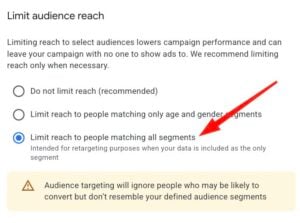
How this was written. Adtomix wrote this article with a language model from Search Engine Watch’s reporting (model: @cf/meta/llama-3.3-70b-instruct-fp8-fast); it describes that reporting rather than adding to it. The original, linked above, is the full story.
Key points from Search Engine Watch’s report
- Google Ads has introduced a new Limit audience reach setting, replacing the Optimised Targeting on/off switch.
- The new setting offers three options for controlling campaign reach to selected audience segments.
- Limiting audience reach may negatively impact campaign performance, according to Google Ads.
Google Ads has introduced a new setting that allows advertisers to control how their campaigns reach specific audience segments. This setting replaces the previous Optimised Targeting on/off switch. According to Search Engine Watch, this change provides more flexibility for advertisers.
The new setting, called Limit audience reach, offers three options for advertisers to choose from. These options determine how campaigns are targeted to selected audience segments. Advertisers can now select the level of targeting that best suits their campaign goals.
The first option, Do not limit reach, allows campaigns to target people beyond the selected audience segments. This option is recommended by Google Ads. The second option restricts targeting to people who match specific age and gender criteria.
The third option limits campaign reach to people who match all selected audience segments. This option is intended for retargeting campaigns where the advertiser's data is the only audience segment. Google Ads notes that limiting audience reach may have negative effects on campaign performance.
By introducing this new setting, Google Ads aims to provide advertisers with more control over their campaigns. Advertisers can now make informed decisions about how to target their audience segments. This change may lead to more effective campaign targeting and improved ad performance.
The introduction of the Limit audience reach setting is a significant update to Google Ads. It reflects the platform's efforts to provide advertisers with more flexibility and control over their campaigns. As advertisers begin to use this new setting, they may need to adjust their campaign strategies to optimize performance.
Questions and answers
What is the new Limit audience reach setting in Google Ads?
The Limit audience reach setting is a new feature that replaces the Optimised Targeting on/off switch and provides three options for controlling campaign reach to selected audience segments.
How may limiting audience reach impact campaign performance?
Limiting audience reach may lead to lower campaign performance, as it restricts the number of people who can see the ads.
What are the three options available in the Limit audience reach setting?
The three options are: Do not limit reach, Limit reach to people matching only age and gender segments, and Limit reach to people matching all segments.